Accelerating Student Loan Payoff with SoFi Round-Ups
Developed as a solo project at CMU, this is a feature concept empowering student loan borrowers to collect spare change, save on interest, and shave years off their loan terms.
Project Overview
The TL;DR
US borrowers feel overwhelmed by massive student loans.
I designed a “Round-Ups” feature, integrated with SoFi Bank, that channels everyday spare change directly toward the loan principal.
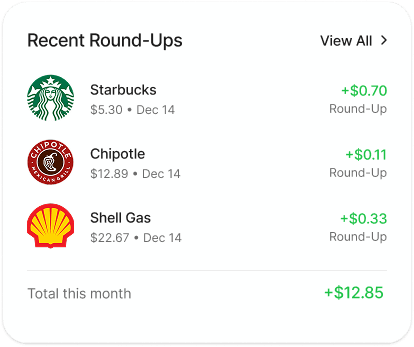
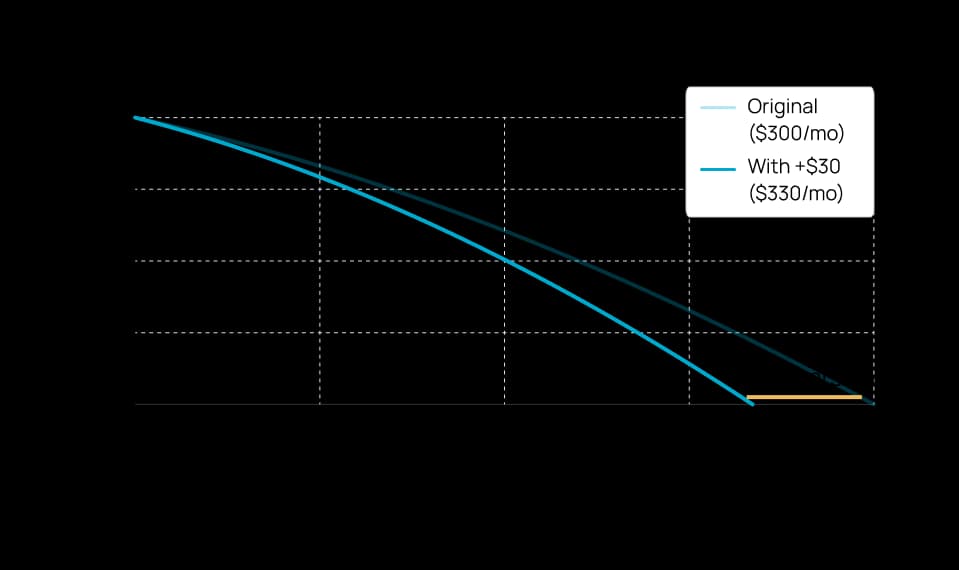
Empowers users to project savings of ~$6,000 in interest and accelerate their debt-free timeline by 3.3 years.
I used Gemini and Claude for research, and Figma Make to rapidly ideate and build those insights into prototypes.

The Problem
The “Invisible” Progress of Repayment
1 in 5 Americans are dealing with student debt. The average borrower owes nearly $40k, and repayment can drag on for 20 years. Because the finish line feels far away, paying it off seems like a distant dream. When progress is invisible, it's easy to lose motivation.
~$40K
Average Debt
~$300/mo
Monthly Payment
~20 Years
Repayment Term
Barbara, 62 years old
The Guardian ↗- Borrowed $60K for her master's degree in nursing
- Has already paid over $66K, but still owes $61K due to interest
- At this pace, won't finish paying until age 91
Insights
Targeting the Principal: Small Payments, Massive Impact
Based on user interviews and social listening on platforms like Reddit, here are two key takeaways:
01
The “Big Money” Myth
Borrowers often think they need a huge amount of money to make a difference. It feels too hard, so some of them just give up.
02
Small Extras, Big Impact
However, success stories from research showed the opposite. Just paying a little extra toward the principal every month can actually shave years off the loan.
How might we help people feel less stressed about collecting that ‘extra’ amount while they are already dealing with heavy monthly payments?
Opportunity
Round It Up, Pay It Down — Collaboration with SoFi Bank
To reduce the ‘pain of paying,’ I was inspired by the Round-Up model. Research shows people are willing to part with spare change because it feels insignificant. The market has already validated this—users are used to rounding up for donating, investing, or saving through everyday purchases.
After considering feasibility, I decided to build this within an existing banking ecosystem. This project is a conceptual feature for SoFi Bank, which has helped over 515K members refinance more than $46 billion in student loans.
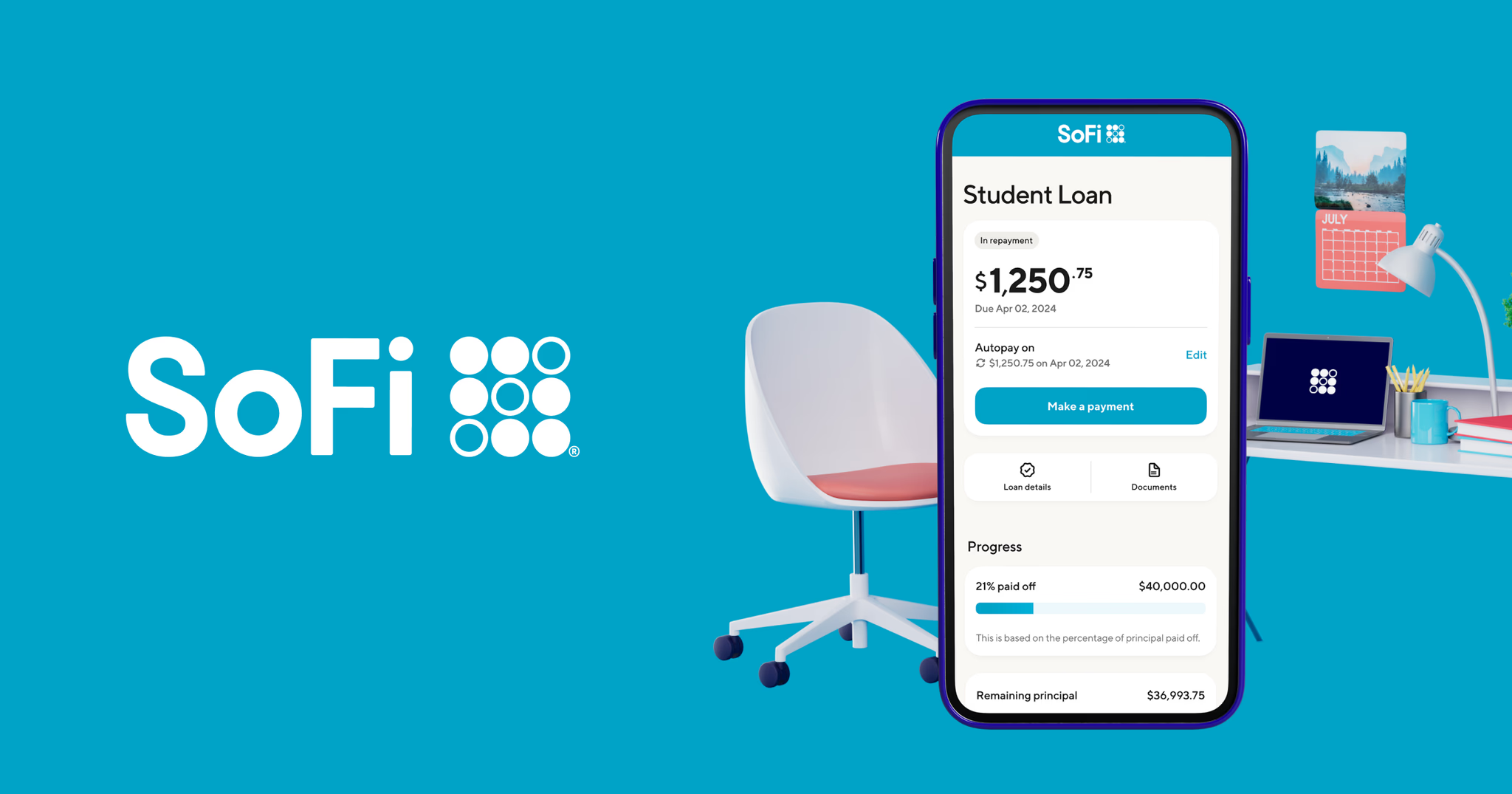
Project Scope & Business Value for SoFi
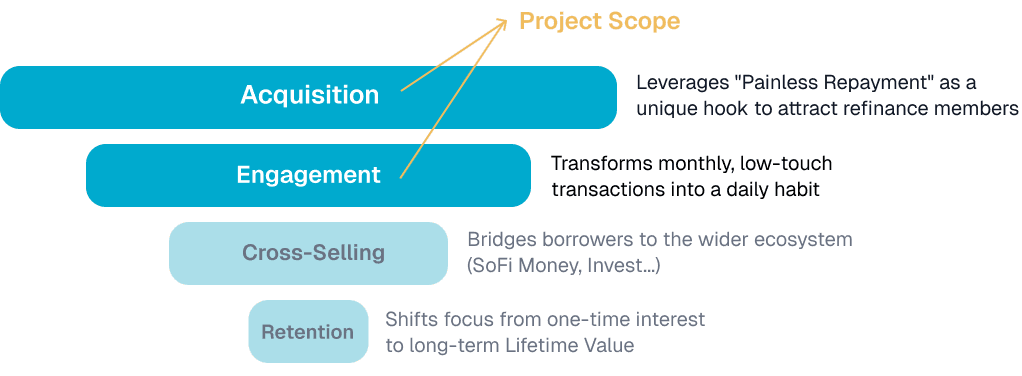
Why not design a standalone app?
+Why collaborate with SoFi?
+Ideation & Iterations
Designing a Round-Up Feature into SoFi's Loan Flow
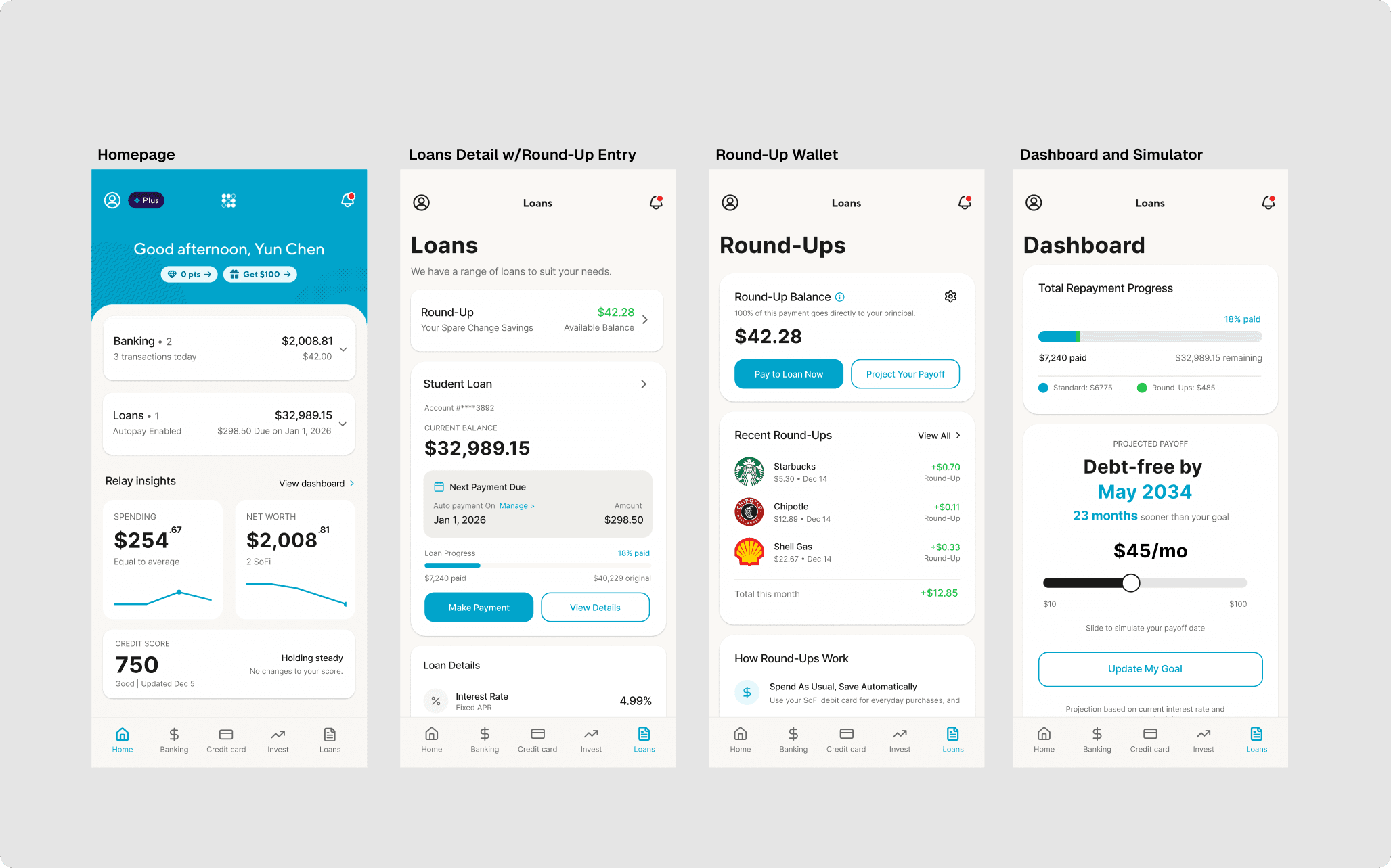
To visualize the concept, I started by mapping the critical user journey to identify daily interaction touchpoints. From there, I prototyped the four key screens that anchor this experience and conducted rapid user interviews to gather early feedback.
💡 AI for speed, human for craft. I used Figma Make for the initial skeleton, but manually refined the final layers. Knowing when to stop prompting and start designing saved time and ensured a professional finish.
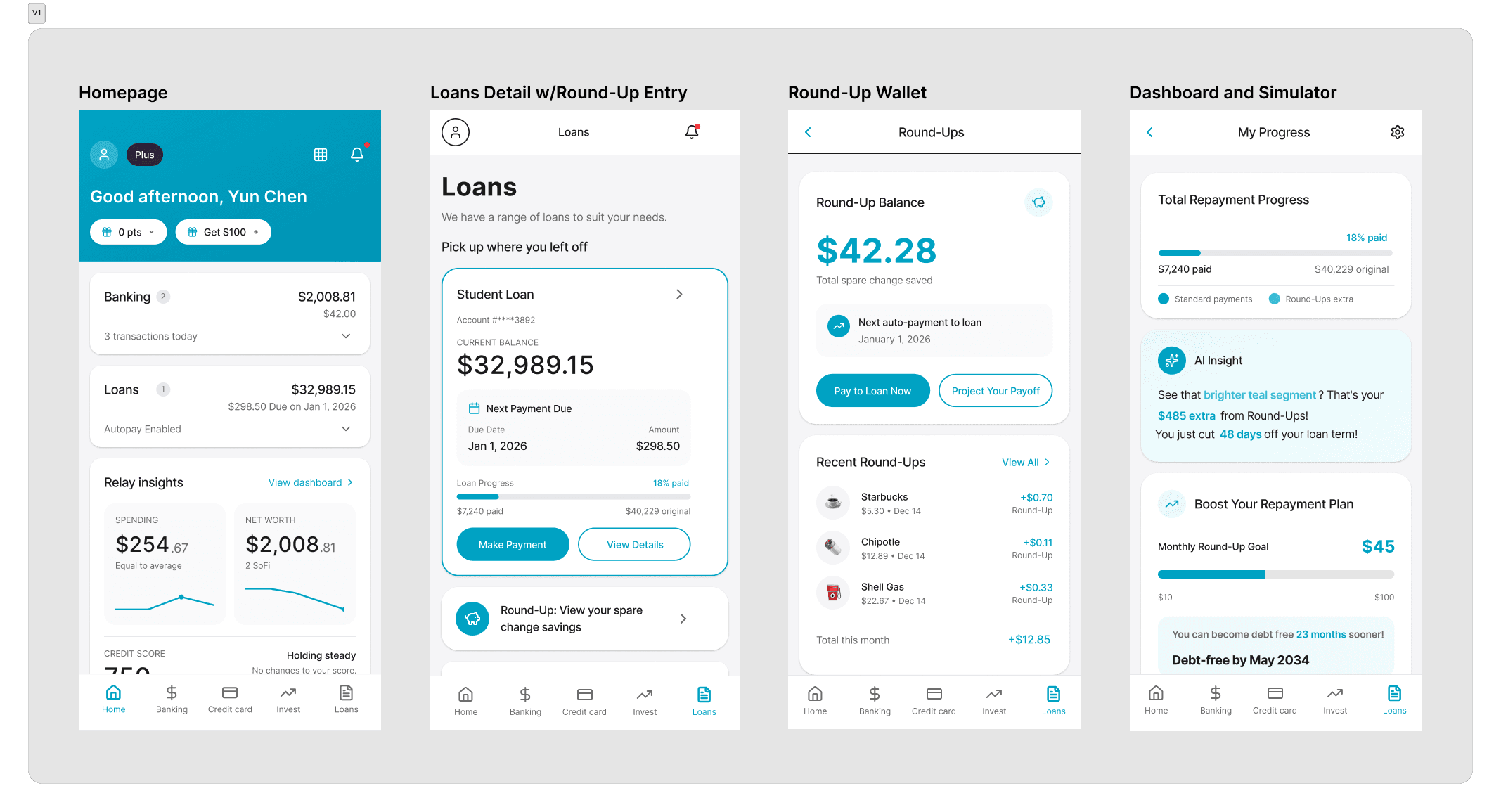
From draft to design
The screens above were generated by Figma Make as a first draft. From there, I studied SoFi's app patterns to realign the visuals with their brand, and refined each screen based on user feedback. Here are the key design decisions that shaped the final result.
Decision 01
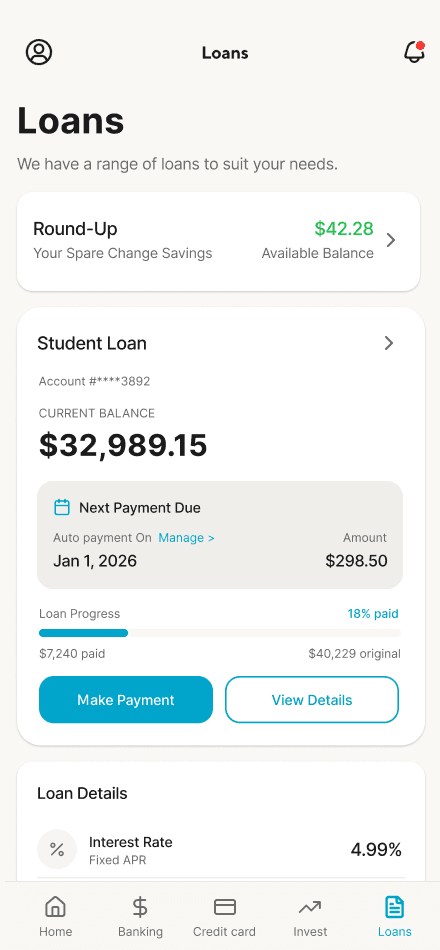
Round-Up Entry Point Redesign
Issue: The Round-Up entry looked like an ad banner, so users ignored it.
Solution: I moved the actual Round-Up balance to the top of the Loans screen. Showing a real number drives action much better than a standard button.
Decision 02
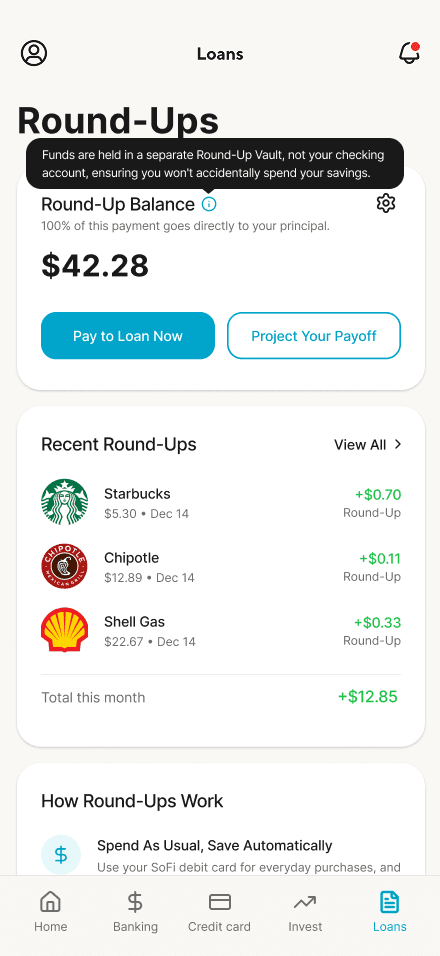
Build trust before asking for action
Issue: Users did not know where their money was stored and felt confused by a manual payment button when auto-pay was on.
Solution: I added a tooltip confirming the funds sit in a separate Vault and clarifying that 100% goes to the principal, giving users a sense of control that increased trust.
Decision 03
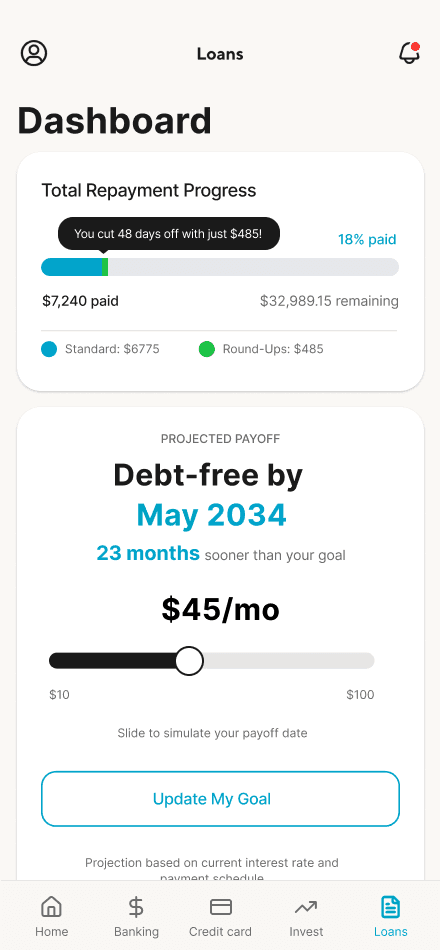
Visualizing long-term impact
Issue: A static chart could not capture how powerful small recurring payments really are.
Solution: I made the slider draggable that shows live timeline changes. Letting users play with the inputs to see exactly how many months they save makes the financial impact visceral.
Outcome
Final Design
During the iteration phase, since I didn't have access to SoFi's official design system, I studied the app's patterns to align with their visual identity.
💡 Workflow Update (Apr 2026): If I were to approach this project today, I would leverage Claude Code to create a structured design.md file documenting SoFi's design system, and then use AI to accelerate rapid UI iterations.
 BeforeAfter
Reflection
Beyond Design: The Era of Product Builders
As AI blurs the lines between disciplines, it empowers me to evolve into a product builder. The question is no longer about my specific role, but rather: “What problem am I solving, and how can I use every tool available to build it?”
💬
Pivot: From Standalone App to Banking Feature
The project pivoted after “reality checking” with a VC. Since interest is the primary revenue source, helping users save it directly conflicts with business profitability. The solution was to reframe the feature as a user acquisition strategy for banks.
🤖
AI Accelerates Output, Not Outcome
AI tools allow me to create screens easily, but I realized that velocity is not a proxy for quality. Good design still lives in the details.